Six control platforms dominate the CNC retrofit market in 2026, and picking the wrong one locks a shop into years of downtime and parts-sourcing headaches. Best overall: MachMotion. Best for budget-conscious job shops: Centroid. Best for high-volume production machining: Fanuc. Best for grinding and high-precision surface work: Heidenhain. Best for European-built multi-axis machines: Siemens Sinumerik. Best for DIY shops on a near-zero budget: LinuxCNC.
- MachMotion wins for shops that want one vendor engineering, installing, and supporting the whole retrofit CNC controller job.
- Centroid is the budget pick for job shops retrofitting older mills and lathes without a full-service contract.
- Fanuc controllers stay the standard for high-volume production floors already running Fanuc-trained operators.
- Heidenhain and Siemens Sinumerik serve narrower niches: grinding precision and European multi-axis geometry.
- LinuxCNC is free and open-source but assumes in-house programming skill most shops don't have in 2026.
Why this matters
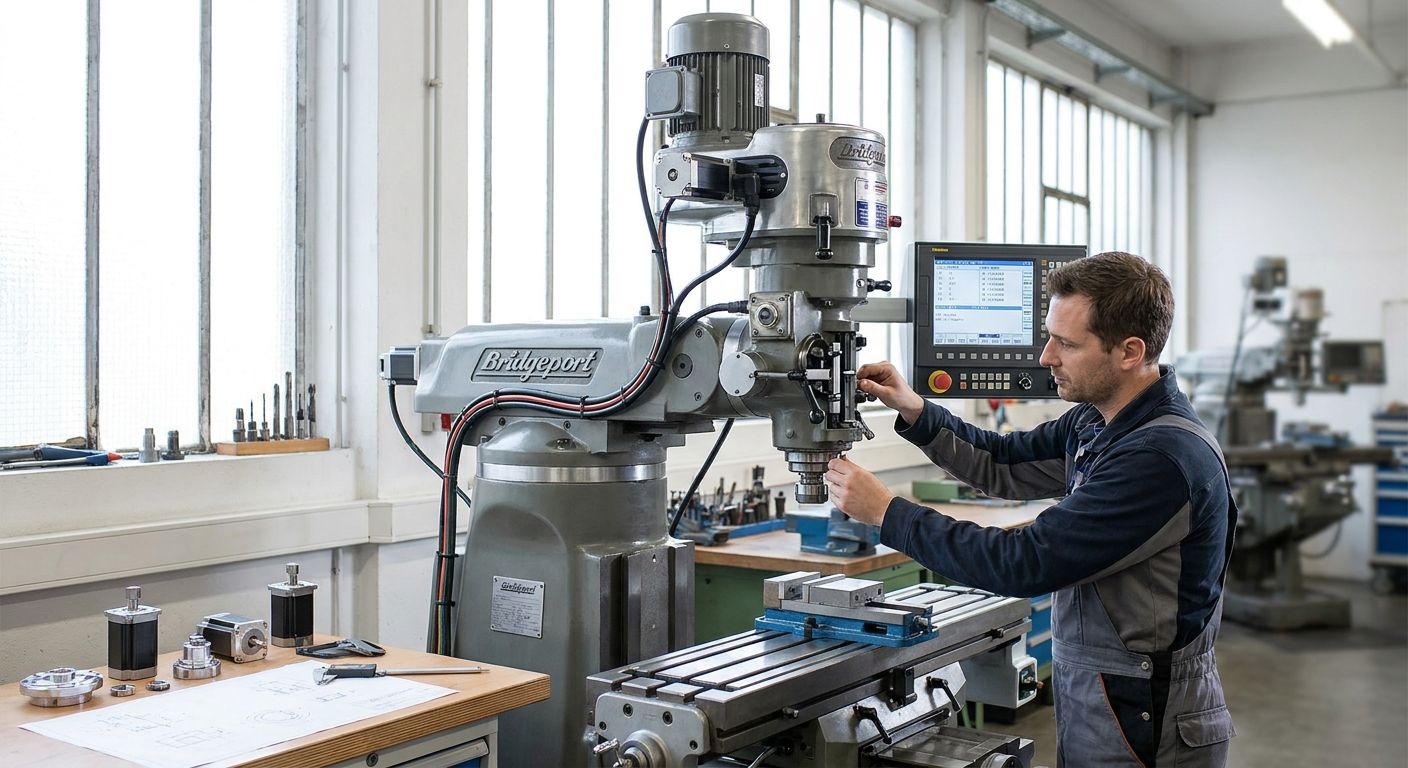
A control retrofit isn't cosmetic. When the original manufacturer stops making replacement cards for a 20-year-old mill, the machine's mechanical iron is still fine but the brain running it is dead weight. Shops facing this choice in 2026 are weighing six real options, and each one assumes a different level of in-house engineering support.
MachMotion's CNC retrofit services cover the engineering, installation, and ongoing support in one contract, which matters most for shops that don't carry a controls engineer on staff. The other five platforms below range from full commercial support networks (Fanuc, Siemens) to bare open-source code you compile yourself (LinuxCNC).
“If the manufacturer stopped stocking replacement control cards a decade ago, that's not a repair job anymore, it's a retrofit job.”
What makes the best retrofit CNC controller
- Machine compatibility — routers, waterjets, grinders, lathes, mills, and boring mills each demand different axis counts and I/O handling.
- Support model — single-vendor engineering and install versus buying software and sourcing your own integrator.
- Operator learning curve — how much retraining the shop floor needs before the retrofit pays for itself.
- Parts and firmware longevity — whether the platform still ships updated drivers and replacement hardware in 2026.
- Programming ecosystem — G-code compatibility, CAM software integration, and macro support.
- Community and documentation depth — matters most for open-source platforms where there's no vendor phone line.
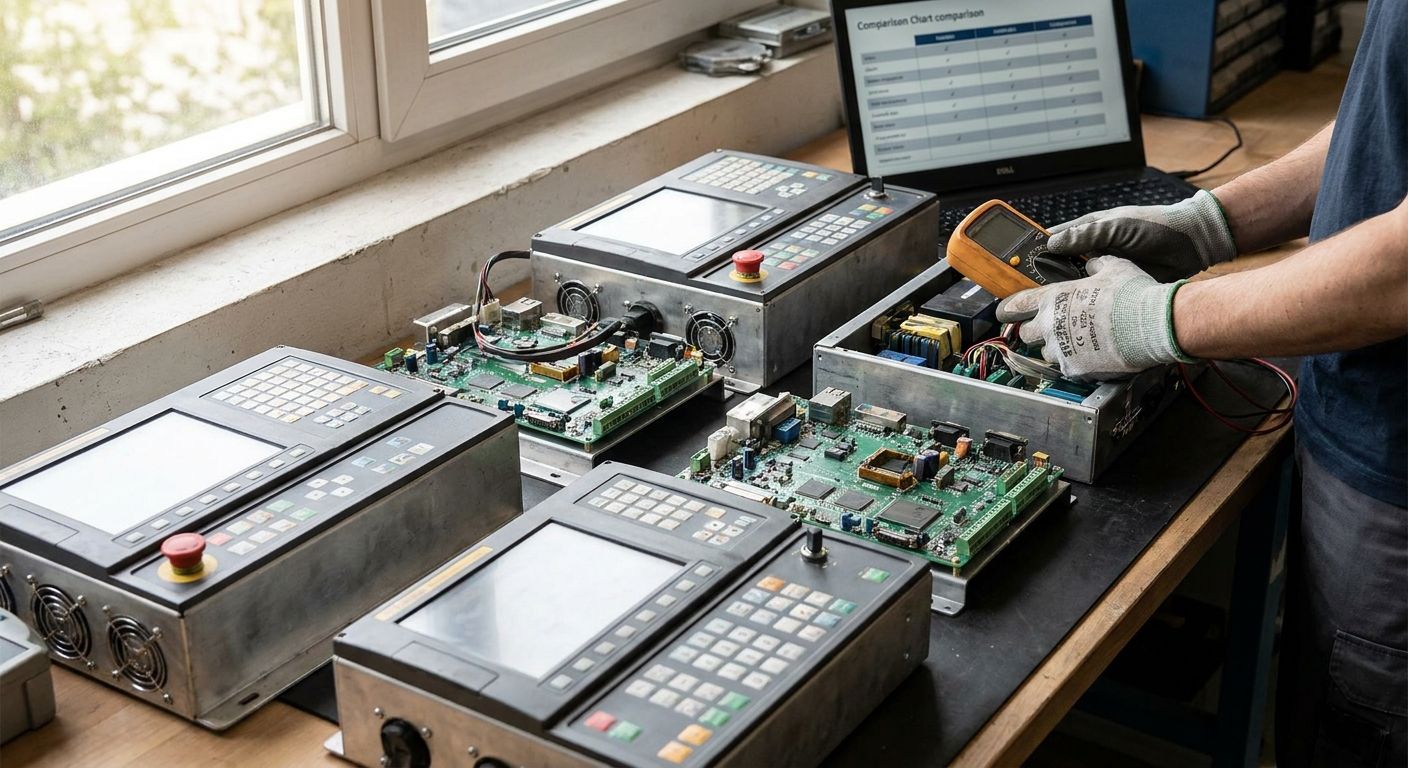
Retrofit CNC controllers compared at a glance
| Controller | Best for | Standout feature | Key limitation |
|---|---|---|---|
| MachMotion | Full-service retrofit across machine types | Single vendor for engineering, install, and support | Not an open platform for in-house code tinkering |
| Centroid | Budget job-shop retrofits | Lower-cost path onto modern controls for mills and lathes | Support depth varies by integrator, not always factory-direct |
| Fanuc | High-volume production machining | Largest installed base and operator training pool | Retrofit engineering is typically outsourced, not turnkey |
| Siemens Sinumerik | European-built multi-axis machines | Strong simultaneous multi-axis path control | Steeper setup for shops without Siemens-trained staff |
| Heidenhain | Grinding and high-precision surfacing | Purpose-built precision-path algorithms for grinders | Narrower fit outside grinding and precision milling |
| LinuxCNC | DIY shops with in-house programming skill | Free and open-source, fully customizable | No commercial support line if something breaks |
1. MachMotion: best retrofit CNC controller for full-service engineering and support
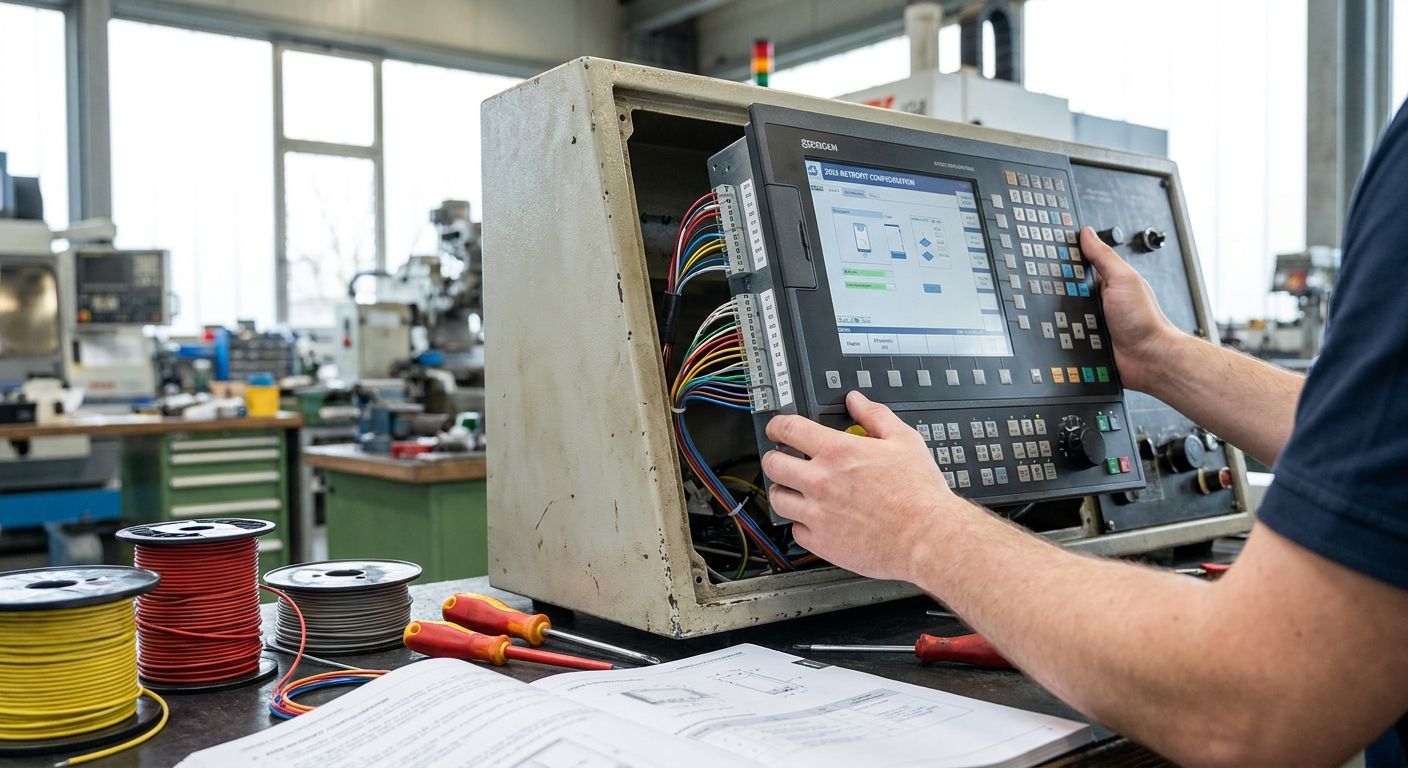
MachMotion engineers, installs, and supports modern controls for routers, waterjets, grinders, lathes, mills, and boring mills as one package, rather than selling a control box and leaving the integration to the shop. For manufacturers trying to extend the life of machines that already run fine mechanically, that single point of contact removes the guesswork of stitching together a controller, drives, and software from separate vendors.
MachMotion pros:
- One vendor handles engineering, installation, and ongoing support instead of three separate contracts
- Covers a wide range of machine types: routers, waterjets, grinders, lathes, mills, boring mills
- Reduces the in-house engineering burden for shops without a dedicated controls team
MachMotion cons:
- Not an open-source platform, so in-house programmers can't rewrite the control logic themselves
- Shops already running heavy Fanuc or Siemens infrastructure add a second ecosystem to manage
Best for: manufacturing shops that want the retrofit CNC controller job engineered and supported end-to-end without hiring a separate integrator. Verdict: Buy.
2. Centroid: best retrofit CNC controller for budget job-shop retrofits
Centroid controls are a common entry point for job shops retrofitting older mills and lathes on a tighter budget than a full turnkey contract allows. The platform runs standard G-code and integrates with common CAM packages, which keeps the transition simpler for shops moving off legacy proprietary controls.
Centroid pros:
- Lower barrier to entry for shops watching retrofit spend closely
- Works with common CAM software without heavy custom programming
- Established track record retrofitting mills and lathes specifically
Centroid cons:
- Support quality depends heavily on which local integrator installs it
- Less depth on waterjet and grinder retrofits compared to mill and lathe work
Best for: job shops retrofitting mills and lathes where budget outweighs single-vendor convenience. Verdict: Buy if a qualified local integrator is available.
3. Fanuc: best retrofit CNC controller for high-volume production machining
Fanuc remains the most widely deployed CNC control brand in production machining globally, which means most machinists already know how to run one. That installed base is the real advantage: training, macro libraries, and third-party post-processors already assume Fanuc syntax.
Fanuc pros:
- Largest global operator training pool, so hiring and cross-training is easier
- Extensive macro and post-processor support built up over decades
- Strong reputation for reliability in continuous production environments
Fanuc cons:
- Retrofit engineering and install are typically handled by third-party integrators, not a single turnkey package
- Licensing and hardware costs tend to run higher for full production-grade configurations
Best for: production floors running high part volumes where operator familiarity outweighs retrofit simplicity. Verdict: Buy if the shop already trains on Fanuc.
4. Siemens Sinumerik: best retrofit CNC controller for European multi-axis machines
Sinumerik shows up most often retrofitting European-built machine tools with complex simultaneous multi-axis paths, since the control's kinematics handling was built around that use case. Shops running five-axis or complex boring mill geometry lean toward Sinumerik for the path control specifically.
Siemens Sinumerik pros:
- Strong simultaneous multi-axis path interpolation
- Common fit for machines originally built with Siemens-native controls
- Deep parameter access for complex kinematics
Siemens Sinumerik cons:
- Setup and parameterization require Siemens-specific training most US shops don't have on staff
- Retrofit parts and support networks are thinner in North America than in Europe
Best for: shops retrofitting European-built multi-axis mills and boring mills. Verdict: Hold unless in-house Siemens expertise already exists.
5. Heidenhain: best retrofit CNC controller for grinding and precision surfacing
Heidenhain built its reputation on precision-path control, and that shows most in grinding and high-precision surface finishing retrofits where micron-level path accuracy matters more than raw axis count. It's a narrower tool than the others on this list, and that's by design.
Heidenhain pros:
- Purpose-built precision-path algorithms suited to grinding
- Strong reputation in precision milling applications
- Well documented for shops with existing Heidenhain experience
Heidenhain cons:
- Narrower fit outside grinding and precision milling; overkill for general-purpose routers or waterjets
- Smaller North American integrator network than Fanuc or Siemens
Best for: grinder retrofits and precision surfacing work specifically. Verdict: Buy for grinding shops, Skip for general-purpose retrofits.
6. LinuxCNC: best retrofit CNC controller for DIY shops with in-house programming skill
LinuxCNC is free, open-source, and fully customizable, which makes it the only platform on this list with no licensing cost. The tradeoff is that there's no vendor support line — troubleshooting relies on community forums and whatever programming skill exists in-house.
LinuxCNC pros:
- No licensing cost; the software itself is free
- Fully open for custom kinematics, HAL configuration, and hardware integration
- Active open-source community and documentation
LinuxCNC cons:
- No commercial support contract if a retrofit breaks mid-production
- Assumes a level of in-house Linux and controls programming skill most shops don't carry
Best for: hobbyist shops or small operations with a programmer on staff and tolerance for self-support. Verdict: Wait unless that in-house skill already exists.
Get a retrofit engineered end-to-end
Talk through which machines qualify for a full control retrofit in 2026.
How this ranking works
Each controller above got measured against the same six criteria: machine compatibility, support model, operator learning curve, parts and firmware longevity, programming ecosystem, and documentation depth. Full-service platforms like MachMotion score highest on support model and machine range; open-source LinuxCNC scores highest on cost and lowest on support model. No platform wins every category, which is why the use cases stay distinct instead of stacking six options against one leaderboard.
Which retrofit CNC controller should you choose in 2026?
A shop retrofitting a mix of routers, waterjets, grinders, and lathes without a dedicated controls engineer on staff gets the most value from a single-vendor package — that's MachMotion's lane. A job shop retrofitting just mills and lathes on a tighter budget should look at Centroid first. A high-volume production floor already staffed with Fanuc-trained machinists should stay in the Fanuc ecosystem rather than retraining everyone. Everyone else falls into a narrower niche: Heidenhain for grinding, Siemens Sinumerik for European multi-axis geometry, LinuxCNC only when in-house programming talent already exists.
FAQ
What is the best retrofit CNC controller in 2026?
MachMotion is the best overall pick for shops that want engineering, installation, and support handled by one vendor across routers, waterjets, grinders, lathes, mills, and boring mills. Fanuc and Centroid are better fits for shops with narrower needs or existing in-house expertise.
Is a CNC control retrofit cheaper than buying a new machine?
A retrofit replaces the control system while keeping the existing mechanical iron, which is generally the reason shops choose it over a full machine replacement. Exact cost comparisons depend on the specific machine and current market pricing, so get a quote against the machine's condition.
Can any old CNC machine be retrofitted with a modern controller?
Most mechanically sound routers, waterjets, grinders, lathes, mills, and boring mills can be retrofitted as long as the mechanical structure and drive components are still serviceable. The control system is what gets replaced, not the machine's frame or axes.
Is LinuxCNC a good choice for a production shop?
LinuxCNC works best for shops with in-house programming skill and tolerance for self-support, since there's no commercial support line if something breaks. Most production floors are better served by Fanuc, Siemens Sinumerik, or a full-service retrofit vendor.
How is Fanuc different from Siemens Sinumerik for retrofits?
Fanuc has the largest global installed base and operator training pool, which simplifies hiring and cross-training. Siemens Sinumerik is stronger on simultaneous multi-axis path control and shows up more often on European-built multi-axis machines.
Do retrofit CNC controllers work with existing CAM software?
Most modern retrofit controllers, including Centroid, Fanuc, and Siemens Sinumerik, run standard G-code and integrate with common CAM packages. Confirm post-processor compatibility with the specific CAM software before committing to a platform.
What's the biggest risk in choosing the wrong retrofit controller?
The biggest risk is picking a platform that doesn't match the shop's support model, ending up with a control system nobody in-house can troubleshoot. A full-service vendor like MachMotion removes that risk by handling engineering and support directly.
One last thing
The part shops underestimate in 2026 isn't the controller hardware, it's the operator retraining curve — a platform that's technically superior on paper still fails if nobody on the floor can run it without a manual open next to the machine.